How Much Does EV Charger Installation Really Cost?
The charger itself is only half the cost. Installation — electrician labor, permits, and potential panel upgrades — can range from $200 to $5,000+ depending on your home's electrical setup. Here's exactly what to expect so there are no surprises.
The Quick Answer
Most homeowners pay $850 to $2,700 total for a Level 2 EV charger installation (charger + labor + permit). If you already have a compatible 240V outlet, it could be as low as $0 for a plug-in charger. If you need a full panel upgrade, it could reach $5,000+.
Full Cost Breakdown
| Cost Component | Low End | Typical | High End |
|---|---|---|---|
| Charger unit | $299 | $400–$600 | $790+ |
| Electrician labor (2–4 hours typical) | $200 | $400–$800 | $1,500+ |
| Permit & inspection | $50 | $100–$200 | $500+ |
| New circuit breaker | $75 | $150–$300 | $500 |
| Wiring (per foot run) | $6/ft | $8–$12/ft | $20+/ft |
| Panel upgrade (if needed) | $500 | $1,300–$3,000 | $5,000+ |
| Total (without panel upgrade) | $550 | $850–$1,500 | $2,700+ |
| Total (with panel upgrade) | $1,500 | $2,500–$4,000 | $7,000+ |
Sources: HomeAdvisor 2025-2026 data, Angi cost guide, EnergySage installation calculator. Electrician rates based on $50–$150/hour national range.
Three Real Scenarios
Your actual cost depends almost entirely on your home's existing electrical setup. Here are the three most common situations:
Easiest Install
You Already Have a 240V Outlet
The situation: You have an existing NEMA 14-50 outlet (the same plug a clothes dryer or oven uses) near where you park. Your panel has capacity.
What happens: You buy a plug-in charger (like the ChargePoint Home Flex plug-in version), plug it in, and start charging. No electrician needed.
Total cost: Just the charger ($299–$790) plus maybe a wall mount bracket.
How common: About 15-20% of homeowners. Mostly homes with an existing dryer outlet in the garage or that were pre-wired during construction.
Typical Install
New Circuit Needed, Panel Has Capacity
The situation: You don't have a 240V outlet where you need it, but your electrical panel has room for a new 50A or 60A breaker.
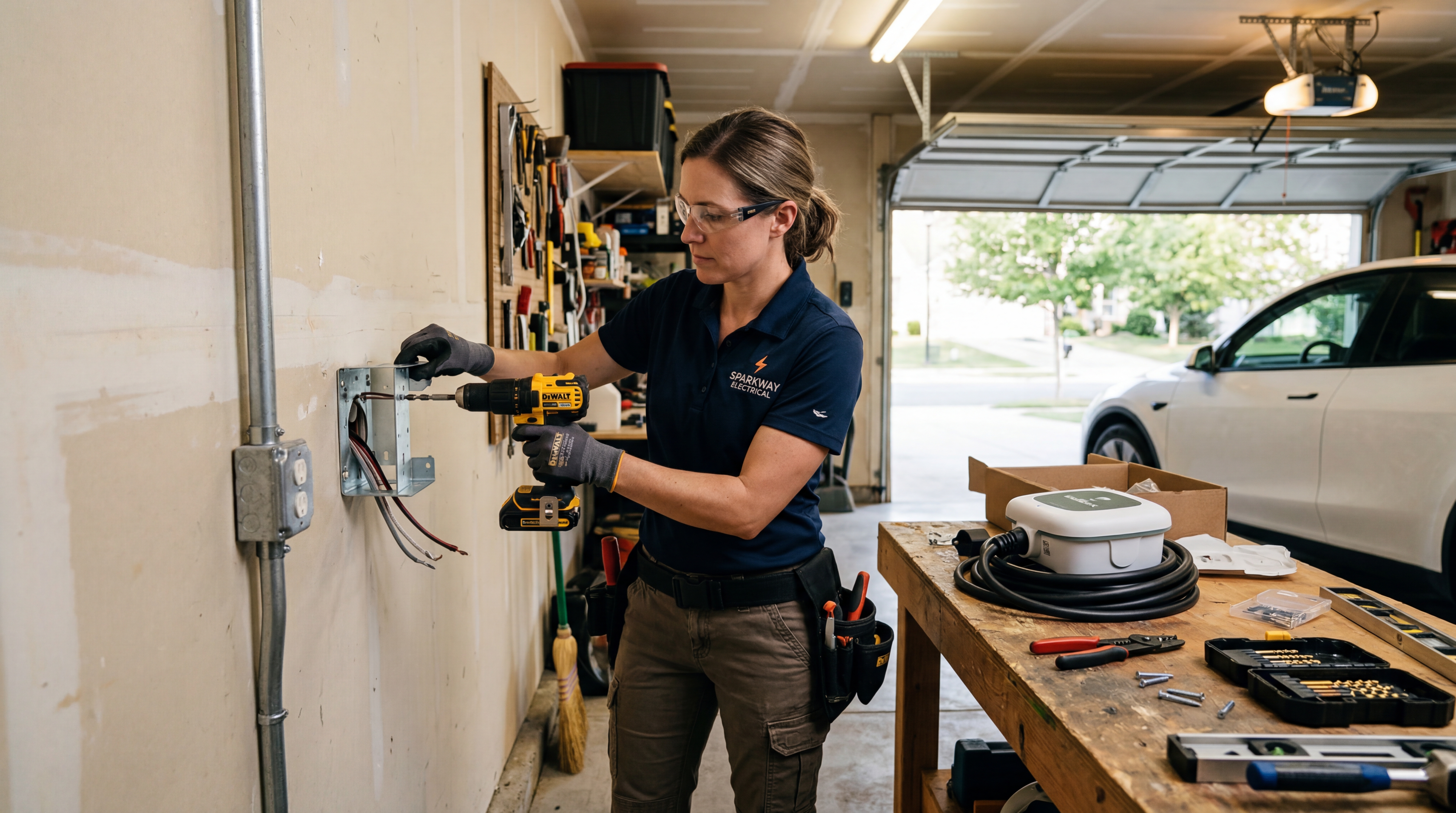
What happens: An electrician runs a new dedicated circuit from your panel to the charger location. Takes 2-4 hours for most installations. You'll need a permit in most jurisdictions.
Cost breakdown:
- Electrician labor: $200–$800 (2-4 hours at $50–$150/hr)
- Materials (wire, breaker, conduit): $150–$400
- Permit: $50–$200
Key variable: Distance from your panel to the charger. Every foot of wire run adds $6–$12. A charger 10 feet from your panel costs much less than one 50 feet away on the other side of the garage.
How common: About 60% of homeowners. This is the standard installation.
Complex Install
Panel Upgrade Required
The situation: Your electrical panel is full or you have an older 100A panel that can't handle the additional load of a 40-50A EV charger circuit.
What happens: An electrician upgrades your panel from 100A to 200A (the most common upgrade), then installs the new EV charger circuit. This is a full-day job and may require utility coordination.
Cost breakdown:
- Panel upgrade (100A → 200A): $1,300–$3,000
- New meter base (if needed): $500–$1,500
- EV charger circuit installation: $400–$1,000
- Permits: $100–$300
How common: About 20-25% of homeowners. More common in homes built before 1990.
Pro tip: Before hiring an electrician, open your electrical panel (the gray metal box) and check two things: (1) Is there an empty slot for a new breaker? (2) What's the main breaker amp rating? If you see empty slots and a 200A main breaker, you're likely in the "Typical Install" category. If the panel is packed full or shows 100A, budget for a potential upgrade.
How to Save Money on Installation
1. Choose a plug-in charger if possible
If you already have a 240V outlet (or can have one installed), a plug-in charger like the ChargePoint Home Flex means you can take it with you if you move. The outlet is a standard installation any electrician can do quickly.
2. Minimize the wire run
Install the charger as close to your electrical panel as possible. Every additional foot of wiring adds cost. If your panel is in the garage, you could save $200-$500 compared to mounting the charger on the far side of the house.
3. Get 3 quotes minimum
Electrician pricing varies significantly. We've seen quotes for identical installations range from $400 to $1,800. Get at least 3 quotes and make sure each one specifies: labor hours, materials list, permit fees, and total price.
4. Check for utility rebates
Many electric utilities offer rebates of $200-$500 for installing a Level 2 home charger. Some even offer free or discounted off-peak electricity rates for EV charging. Check your utility's website or call them before installation.
5. Use the federal tax credit
The Section 30C Alternative Fuel Vehicle Refueling Property Credit covers 30% of installation costs up to $1,000 for residential installations in eligible census tracts. This credit is available through at least June 2026. Check with your tax advisor for current eligibility details, as requirements change.
Source: IRS Section 30C. Eligibility is based on census tract location — not all areas qualify. Consult a tax professional.
6. Consider a lower-amperage charger
A 40A charger needs a 50A breaker. A 48A charger needs a 60A breaker. If your panel is tight on capacity, choosing a charger with adjustable amperage (like the ChargePoint Home Flex) lets you dial it down to work with a smaller breaker — potentially avoiding a panel upgrade entirely.
What to Ask Your Electrician
Before hiring, ask these questions:
- "Does my panel have capacity for a 50A or 60A breaker?" — This determines if you need a panel upgrade (the biggest cost variable).
- "What's the total wire run distance?" — Longer runs = higher materials cost.
- "Is a permit required in our jurisdiction?" — Most areas require one. Some electricians include permit fees in their quote, others don't.
- "Is the quote all-inclusive?" — Get confirmation that labor, materials, permit, and inspection are all included. No surprise fees after the job.
- "Have you installed EV chargers before?" — It's not complicated work for a licensed electrician, but experience means fewer issues.
Do I Actually Need an Electrician?
For a plug-in charger with an existing outlet: No. If you have a NEMA 14-50 outlet where you need it, you just plug in. No different from plugging in a dryer.
For a new circuit or hardwired charger: Yes. This involves working inside your electrical panel with live 240V circuits. It's not a DIY project — it's dangerous if you're not trained, and most jurisdictions require a licensed electrician for this work. It also needs a permit and inspection.
Bottom line: Don't try to save $400 on labor by doing electrical work yourself. A bad installation can cause a fire, void your homeowner's insurance, or fail inspection when you sell the house.
Frequently Asked Questions
How long does installation take?
A standard installation (new circuit, no panel upgrade) takes 2-4 hours. A panel upgrade adds another 4-8 hours. The actual work is usually done in one day, but the full process — getting quotes, pulling permits, scheduling inspection — can take 1-4 weeks.
Can I install a Level 2 charger in an apartment?
It's possible but complicated. You'll need permission from your landlord or HOA, access to a dedicated parking spot near an electrical panel, and likely a separate meter. Some states (like California) have "right to charge" laws that require landlords to allow EV charger installation. Check your state's laws and talk to your building management first.
Is it cheaper to install indoors or outdoors?
Indoor (garage) installations are typically $200-$500 cheaper because there's no weatherproofing, conduit protection, or trenching needed. If you have a garage, install the charger inside it.
What if I have a 100A panel?
You may still be able to install an EV charger without a full panel upgrade. Options include: using a charger with adjustable amperage set to a lower setting, installing a load management device (like the Emporia with PowerSmart), or adding a subpanel. Discuss these options with your electrician before committing to a full panel upgrade.
Does installing an EV charger increase home value?
Studies suggest a home EV charger can increase property value by $5,000-$15,000, especially in markets with high EV adoption. It's increasingly seen as a desirable home feature, similar to a finished garage or updated kitchen. The charger itself doesn't add much, but the dedicated 240V circuit is a permanent improvement to the home's electrical infrastructure.
Ready to pick a charger?
See our 7 Best Level 2 EV Chargers for 2026 — we cover price, specs, and which one fits your situation.
Last updated March 2026. Cost data sourced from HomeAdvisor, Angi, EnergySage, and Qmerit. Prices vary by region and may have changed since publication.